
If you’ve ever stood in your backyard dreaming about fresh eggs and a couple of hens pecking around while you drink your coffee, friend, I see you. I AM you. 🐔
We started raising chickens here on our 30 acres in the Town of Howard about a year and a half ago, and nobody prepared me for how much personality a chicken has, or how fast you start calling them by name.
Meet Our Flock
Right now we have about 30 chickens. 😂 About 15 are from our original flock, and about 15 more joined our family this past spring. So technically we have two flocks, and they’re still working on becoming one big happy family. (Integrating flocks is a whole thing. More on that below!)
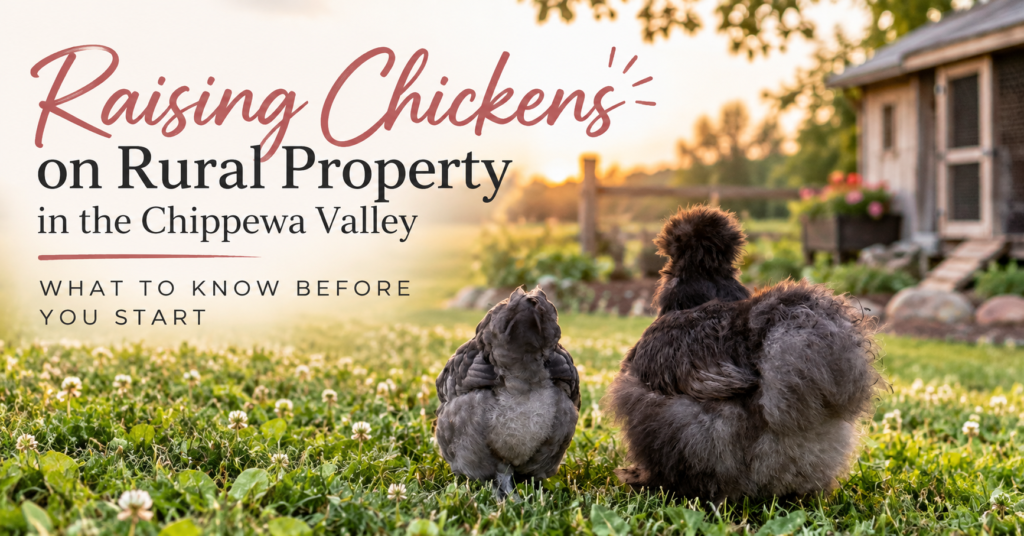
We have three silkies, and one of them is by far the family favorite. Her name is Stormy, she’s a black silkie, and my boys absolutely adore her. She’s also the only hen we’ve ever let go fully broody and hatch her own baby… which turned out to be a rooster. 🙈 And let me tell you, he is LARGE compared to his tiny mama, especially considering his dad is a bantam Wyandotte.
From our newer flock, my personal favorite is our cochin. Don’t tell the others. 💕
But before you order that adorable little coop off Pinterest, let’s talk about what actually goes into raising chickens (or any animals) on rural property in the Chippewa Valley. There’s a big difference between “cute idea” and “can I actually do this on my land,” and I’d rather you know the real version going in.
Check Your Zoning and Township Rules First
This is the boring part. It’s also the most important part.
Not every property in the Chippewa Valley plays by the same rules. Some townships allow chickens with very few restrictions. Some cap how many you can have. Some require a minimum lot size or a certain distance from your property line or your neighbor’s house.
And if you’re inside city or village limits, expect a few more rules. Every city is a little different, but here’s what usually comes up:
A limit on how many hens you can have. Usually just a handful, and sometimes it depends on your lot size.
No roosters. Pretty much across the board in town. (Your neighbors will thank you at 5 AM.)
Coop placement rules. Many cities require your coop to sit a certain distance from your house, your neighbor’s house, and your property lines.
A plan for the poop. Yep! Some cities want to know exactly how you’ll store and get rid of chicken waste so it doesn’t turn into a smell (or a fly) problem for the neighborhood.
A license or permit. The City of Eau Claire, for example, requires a license to keep backyard hens.
Rural townships tend to be more relaxed, but “more relaxed” still means you need to ask.
Before you buy a single chick, call your township office, city hall, or your county zoning department and ask directly. It’s a five minute phone call that can save you a very awkward conversation later. 😬
Register Your Flock With the State (Yes, Really!)
Here’s one I didn’t even know about until recently: Wisconsin requires anyone who keeps livestock to register their location with the state, and that includes backyard chickens. It doesn’t matter if you have three hens in town or fifty birds on acreage. There’s no minimum flock size and no zoning exemption. 🤯
The good news? It’s free, your info is kept confidential, and you only have to renew every three years. It helps the state reach animal owners quickly if there’s ever a disease outbreak nearby, and some cities even ask for proof of registration before they’ll give you a chicken permit. You can register through Wisconsin Livestock Premises Registration. Easy peasy. ✅
What Raising Chickens on Rural Property Actually Looks Like
Chickens are low maintenance as far as farm animals go, but low maintenance doesn’t mean NO maintenance. Here’s what you’re really signing up for: daily food and water, a coop that’s actually predator-proof (not just cute on Pinterest), regular bedding changes, and collecting eggs every single day.
Here’s our setup: we bought an Amish-built coop and added our own attached run. Then we customized the inside with roosting bars, a poop shelf (total game changer for clean up, trust me), and a separate quarantine section. It’s big, it’s beautiful, and yes, it’s a little fancy. 😍
If I could give you one setup tip, it’s this: plan for a quarantine space from the start. Whether you’re bringing home new birds, separating one that isn’t feeling well, or slowly introducing two flocks like we are, you’ll be SO glad you have it.
Then there are Wisconsin winters, which are no joke for animals. Here’s what we do to keep our flock comfy when the temps drop: a heated waterer (non negotiable, trust me 🙃), greenhouse panels around the run to block the wind and snow, and a small heater designed specifically for coops for those super cold days.
Predators are a real conversation too. Foxes, hawks, raccoons, mink, and the occasional coyote are all part of life out here. We learned that the hard way when a mink got one of our rabbits who lived right next door to the chickens. It was heartbreaking. Mink can squeeze through surprisingly small gaps, so a flimsy coop or plain chicken wire just won’t cut it. Hardware cloth is your best friend.
And real talk, sometimes things just go sideways. We’re working through some health issues with our flock right now and still trying to figure out what’s going on. Chickens are really good at hiding when they don’t feel well, so get to know what’s normal for your birds and find a local vet who sees poultry BEFORE you need one. It’s all part of the learning curve, and every bump makes you a better chicken mama. 🐔
And please, PLEASE don’t be the person who walks into Farm & Fleet in the spring, sees those adorable little chicks under the heat lamp, and brings six of them home without a plan. 🐣 I know. They’re SO cute. But know your rules, have your coop set up, and have your supplies ready first. Your future self (and your chicks) will thank you.
Thinking Bigger Than Chickens?
If goats, sheep, or a horse are on your dream list, the planning gets a lot more serious. Fencing, shelter, pasture rotation, vet care, and hay for winter all become real line items in your budget. Your zoning rules matter even more here too, since some areas limit how many larger animals you can have based on your acreage.
It’s a beautiful life. It’s also a LIFE, not a weekend hobby. Start small, learn as you go, and add animals once you’ve got your routine down.
What This Means If You’re Buying Acreage in the Chippewa Valley
If you’re house hunting right now and this kind of life is the dream, here’s what I tell my buyers looking at acreage in the Chippewa Valley: don’t just fall in love with the house. Walk the land.
Ask about the zoning before you write an offer. Look at the drainage and where water sits after a rain. And keep an eye out for existing outbuildings. A lot of my favorite acreage listings have an old shed or barn that just needs a little love to become a coop or a shelter for a couple of goats, and that can save you thousands compared to building from scratch.
And if you’re SELLING acreage with an existing coop, barn, or fencing already in place, don’t undersell that in your listing! Buyers dreaming of this life notice it immediately, even if they’re not ready to say “homestead” out loud yet. 💕
It’s Worth It (Most Days)
I won’t pretend every day is a Pinterest board. Some mornings it’s thirty degrees and I’m out there in my pajamas under a coat, checking waters and counting heads, questioning my life choices. 😂
But then my boys come running in with still-warm eggs like they found buried treasure, or I catch them out there spoiling Stormy with treats, and yeah. It’s worth it.
If you’re dreaming about this kind of life on your own piece of the Chippewa Valley, whether that’s a few chickens or a whole homestead, I’d love to help you find land that can actually hold that dream. Grab my Beginner’s Guide to Homesteading in the Chippewa Valley for a walkthrough of exactly this, zoning questions included, and come hang out with us in my Homesteading Mamas of the Chippewa Valley Facebook group. It’s full of people figuring this out right alongside you. 💕
New to the area? Start with my guide to moving to Eau Claire and Chippewa Falls, or let’s chat about what you’re looking for.
Chat soon, friend! 🐣💕